Seven days is enough to experience three very different sides of Nepal.
A single week can give you the chance to visit Kathmandu's historic temples and courtyards, visit the Himalayas from Pokhara, and end up amongst the forests and wildlife of the Chitwan.
If you are visiting Nepal for the first time, the best 7 days Nepal itinerary is Kathmandu to Pokhara to Chitwan and back to Kathmandu. It allows a natural progression to the beautiful scenery of the mountains and the wildlife without cramming too many locations into a single tour.
The choice of routes, combined with transfer times and avoiding having too many packed days, are all important.
Key Takeaways
Best route: Kathmandu → Pokhara → Chitwan → Kathmandu
Best time to split: 2 days Kathmandu, 2 days Pokhara, 2 days Chitwan
Best for: First-time visitors seeking culture, mountains and wildlife
Fastest option between destinations: Domestic flights
Best overall seasons: October–November and March–May
Key planning guideline: Allow for a buffer for road travel and your international trip.
Is 7 Days Enough to Visit Kathmandu, Pokhara & Chitwan?
Yes. Seven days works well for a focused Nepal travel itinerary covering Kathmandu, Pokhara and Chitwan.
This hike is for those who are looking for a first-time trip to Nepal and are not planning on staying for a few days. It also ensures that the trip remains manageable, with a minimum change of hotels.
Trekking, Lumbini and the Everest region are better added to a longer Nepal trip.
Your 7-Day Nepal Itinerary at a Glance
Day | Destination | Highlights |
Day 1 | Kathmandu | Arrive, relax and spend the evening in Thamel |
Day 2 | Kathmandu | Pashupatinath, Boudhanath, Swayambhunath, Patan |
Day 3 | Pokhara | Transfer, Phewa Lake, Lakeside |
Day 4 | Pokhara | Sarangkot, Davis Falls, World Peace Pagoda |
Day 5 | Chitwan | Relaxed evening with transfer to Tharu culture. |
Day 6 | Chitwan | Jeep safari, canoe and wildlife |
Day 7 | Kathmandu | Boarding and departure |
Days 1-2: Kathmandu
Start your Nepal trip in Kathmandu, the capital and home to ancient history, living traditions, and a blend of energy.
Day 1: Arrival and an Easy Start
Upon reaching Tribhuvan International Airport, wait for immigration, Baggage Collection and transfer to the city.
Eligible travelers can obtain a tourist visa on arrival. Current fees are USD 30 for 15 days, USD 50 for 30 days, and USD 125 for 90 days. (Department of Immigration)
Light the first night. A walk through Thamel is an easy introduction to Kathmandu's restaurants, cafés, and shops.
Located in Tahachal, The Soaltee Kathmandu is situated 12 acres of landscaped grounds, about 9 km from Tribhuvan International Airport and is a more serene location for travellers seeking a quieter base.
The selection of the area is important on such a short trip, since sites visiting or transfers to and from the airport can take up time. You can compare the main areas in Kathmandu before booking with our guide on where to stay in Kathmandu.
Day 2: Kathmandu Heritage
Explore Kathmandu Valley's main historical attractions on your second day.
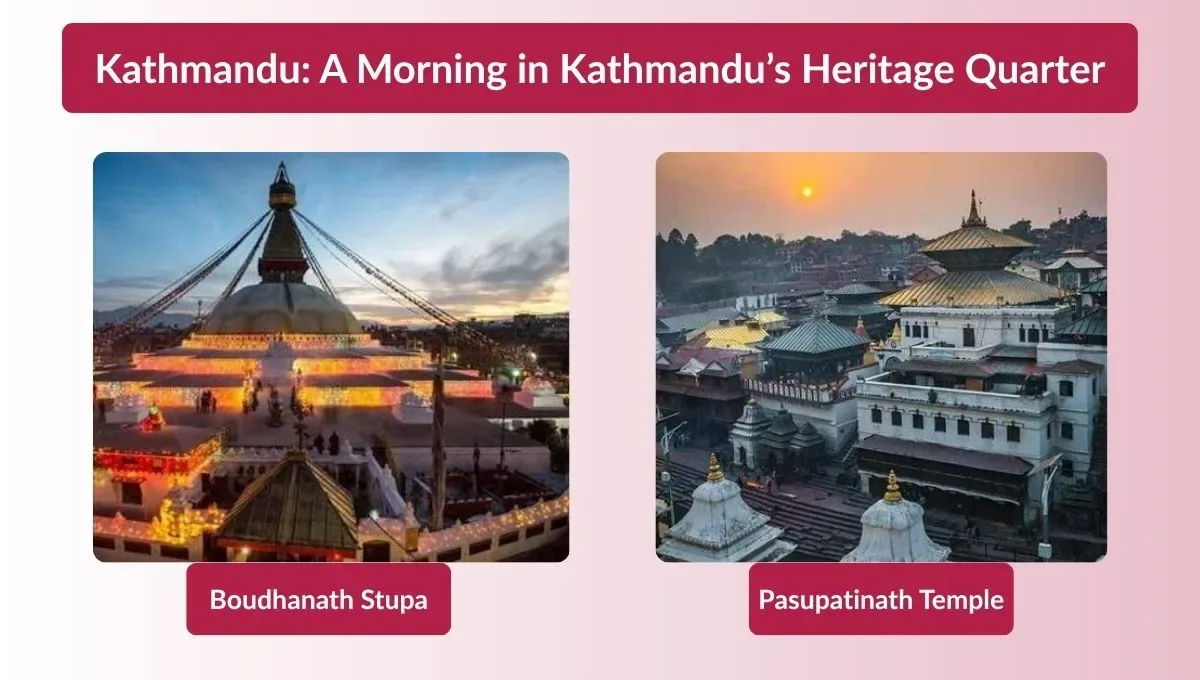
Start with Pashupatinath Temple; one of the most important Hindu pilgrimage sites in Nepal. The present entry fee for foreign nationals is NPR 1,000 per entry. (Nepal Tourism Board)
Head to Boudhanath Stupa and then on to Swayambhunath with its high-altitude views over Kathmandu Valley.
The journey ends at Patan Durbar Square, which features more temples, palace courtyards and traditional Newari architecture to explore the valley's heritage.
In the late afternoon, head back to your hotel and relax in the evening.
Day 3: Kathmandu to Pokhara
Flying is typically the quickest way to travel for a week's stay.
The Kathmandu–Pokhara flight takes about 25 minutes. Traveling by road will require much more time, so allow for the entire trip.
Once in Pokhara, head towards Phewa Lake and Lakeside. The easy first afternoon is a boat trip across the lake and a visit to Tal Barahi Temple.
For travelers who prefer to stay close to the lake, Soaltee Westend Lakeside Pokhara offers a Lakeside location with views towards Phewa Lake and the Annapurna range.
Try to make this first afternoon as relaxed as possible. Pokhara is as much about its atmosphere and views as its sightseeing list.
Day 4: Pokhara : Mountain Views and Lakeside
Start early at Sarangkot, one of Pokhara's best-known sunrise viewpoints.
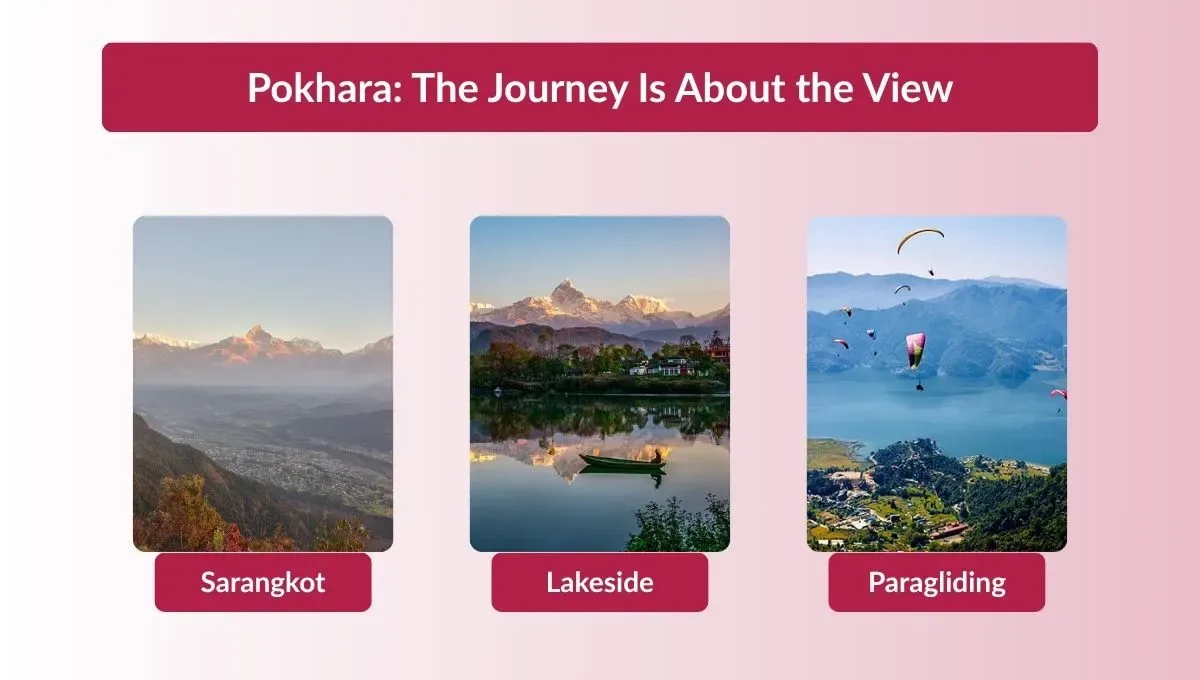
On a clear morning, the Annapurna range and Machhapuchhre can provide some of the most memorable mountain views of the trip. Visibility depends on the weather, so flexibility is important.
After breakfast, visit Davis Falls and Gupteshwor Mahadev Cave.
Continue to the World Peace Pagoda for another perspective over Phewa Lake and the surrounding landscape.
Leave the afternoon flexible for Lakeside, a boat ride or tandem paragliding, depending on weather and availability.
Day 5: Pokhara to Chitwan
The journey to Chitwan changes the landscape dramatically as you leave the hills and move towards Nepal's subtropical Terai.
You can travel by road or fly from Pokhara to Bharatpur, followed by a road transfer to Chitwan. The Pokhara–Bharatpur flight takes about 20 minutes.
Once you arrive, slow the pace. A Tharu cultural experience can be a useful introduction to your wildlife activities.
Chitwan National Park is a UNESCO World Heritage Site and one of Nepal's best-known wildlife destinations. The current entry fee for foreign visitors is NPR 2,000 per person per entry, plus 13% VAT. (Nepal Tourism Board)
Because park permits, entry charges and activity arrangements can be confusing for first-time visitors, our guide to Chitwan National Park entry fees and permits is a useful reference before your safari day.
For a comfortable base near the park, Soaltee Westend Resort Chitwan offers a resort setting in Patihani.
Day 6: Chitwan Wildlife Experience
Begin early with a jeep safari, when the forest is cooler and wildlife activity can be more rewarding.
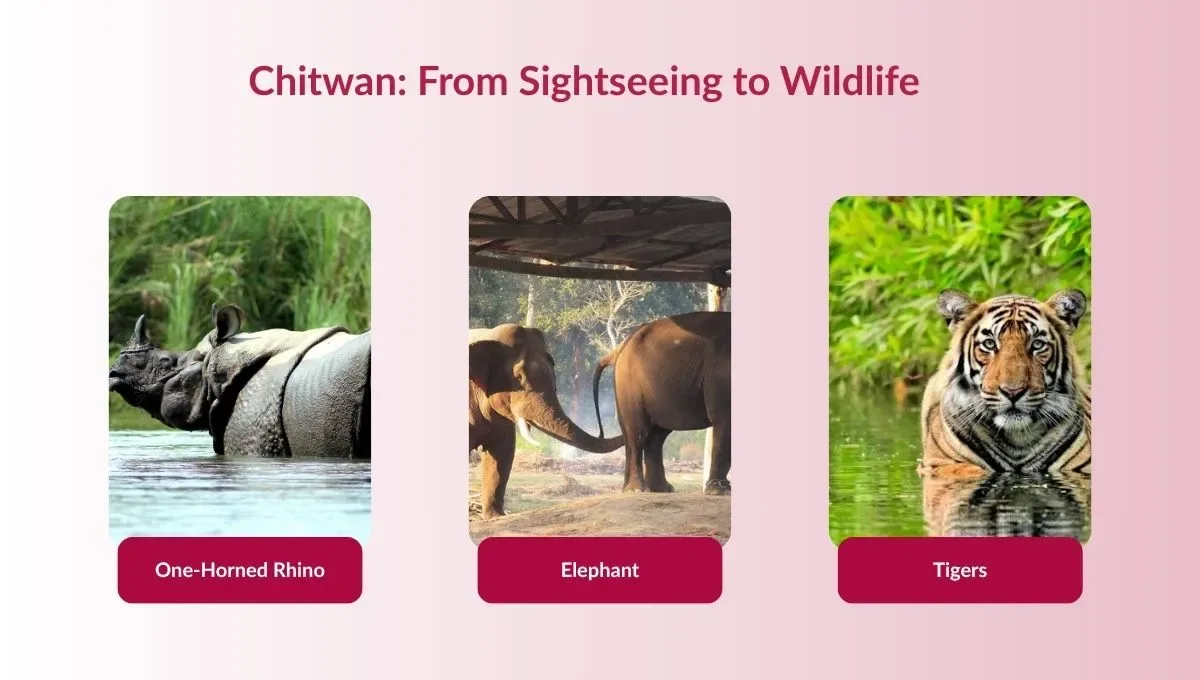
Chitwan is known for its one-horned rhinoceros, deer, crocodiles and diverse birdlife. Bengal tigers are also present, although wildlife sightings are never guaranteed.
A canoe ride offers a slower perspective on the river environment and the surrounding landscape.
Depending on your interests and schedule, you can also consider a guided nature walk or a visit to the Chitwan Elephant Breeding Camp. The current entry fee for foreign nationals is NPR 100. (Nepal Tourism Board)
Do not feel pressured to fill every hour. Chitwan is best experienced with enough time to observe the forest rather than rush from one activity to the next.
Day 7: Chitwan to Kathmandu
Your final transfer should be planned around your international departure.
The Bharatpur–Kathmandu flight takes about 25 minutes. Road travel takes considerably longer and can be affected by traffic and road conditions.
This is also where smoother travel planning can make a real difference.
Through the Soaltee Heritage Club App, members can book participating Soaltee hotel stays and Buddha Air domestic flights in the same app, reducing the need to move between separate booking platforms. Buddha Air serves key domestic destinations including Kathmandu, Pokhara and Bharatpur.
Check this out for more information: Budha Air Flights Now Available in Soaltee Heritage Club App
For a multi-city Nepal trip itinerary, that can be particularly convenient when arranging the Kathmandu-Pokhara and Pokhara-Bharatpur sectors around your hotel stay.
Allow a comfortable buffer between your arrival in Kathmandu and your international departure. On the final day, reliability matters more than fitting in one last attraction.
This might be helpful for you: How to Use the Soaltee Heritage Club App (Full Guide)?
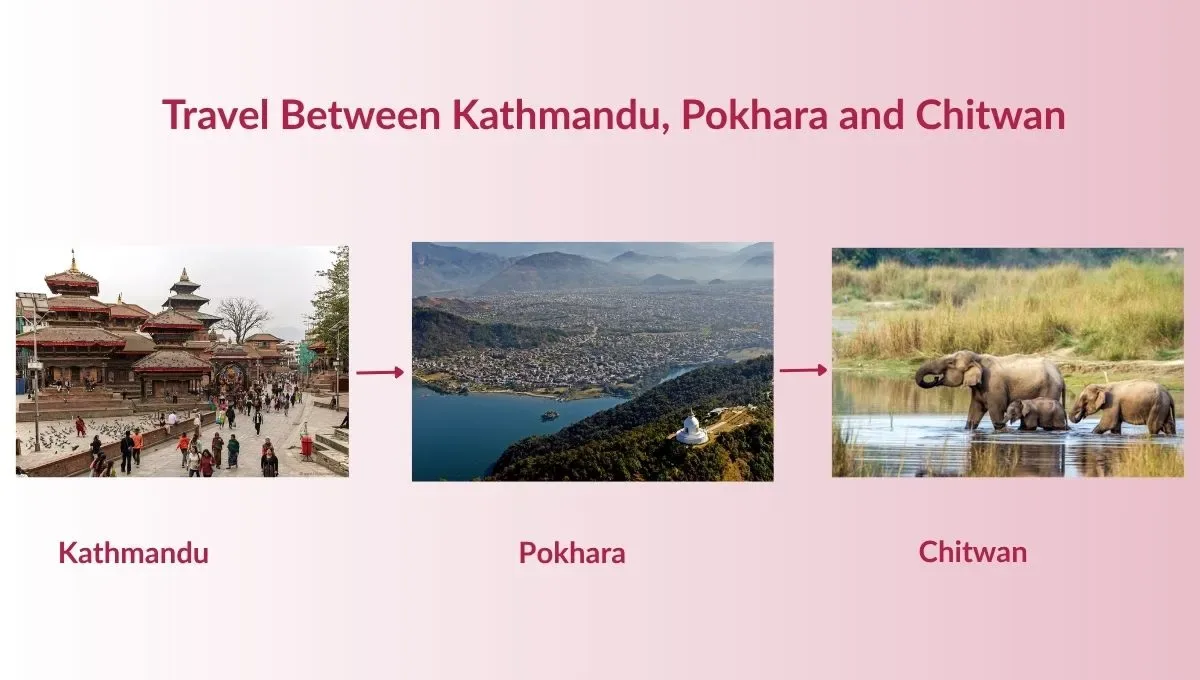
How to Travel Between Kathmandu, Pokhara and Chitwan?
Route | Fastest Option | Alternative |
Kathmandu → Pokhara | Flight, about 25 min | Road |
Pokhara → Chitwan | Flight to Bharatpur, about 20 min | Road |
Chitwan → Kathmandu | Flight from Bharatpur, about 25 min | Road |
These are flight times rather than complete door-to-door journey times. Airport procedures and road transfers should also be included when planning your days.
For travelers staying within the Soaltee ecosystem, the Buddha Air integration in the Heritage Club App can make the flight-booking side of a multi-city journey simpler.
Where to Stay on a 7-Day Nepal Trip?
Accommodation matters more when time is limited.
In Kathmandu, The Soaltee Kathmandu provides a spacious base in Tahachal with convenient airport access.
In Pokhara, Soaltee Westend Lakeside Pokhara is near Phewa Lake and works well for travelers planning early starts to Sarangkot.
In Chitwan, Soaltee Westend Resort Chitwan offers a resort base in Patihani for the wildlife portion of the trip.
The advantage of choosing accommodation with convenient access is simple: less time spent on transfers means more time experiencing the destination.
Best Time for a 7-Day Nepal Itinerary
Season | Months | What to Expect |
Autumn | October–November | Clearer skies and strong mountain visibility |
Spring | March–May | Warmer weather and flowering landscapes |
Winter | December–February | Cooler mornings and generally clear days |
Monsoon | June–September | Rain and less reliable mountain visibility |
For this one-week Nepal itinerary, October–November and March–May are strong choices.
For Chitwan specifically, Nepal Tourism Board identifies October–March as a favorable period, while the monsoon months are wetter. (Nepal Tourism Board)
Nepal Travel Essentials for First-Time Visitors
Visa: Current tourist visa-on-arrival fees are USD 30 for 15 days, USD 50 for 30 days, and USD 125 for 90 days. (Department of Immigration)
Currency: Nepal uses the Nepali Rupee (NPR). Cards are widely accepted at established hotels and businesses, while cash remains useful for smaller purchases and local services.
Packing: Comfortable walking shoes, light layers, sunscreen and insect protection are useful. Chitwan is warmer and more humid than Kathmandu and Pokhara.
Transport: Domestic flights are short, but allow time for airport procedures, road transfers and possible delays.
Experience Nepal in Seven Days
The best 7-day Nepal itinerary is not the one with the longest list of attractions.
It is the one that gives you enough time to experience each destination properly: Kathmandu for culture, Pokhara for mountain scenery, and Chitwan for wildlife.
For first-time visitors, the Kathmandu–Pokhara–Chitwan route offers a balanced introduction to Nepal without making the journey unnecessarily complicated.
With the right hotel locations, sensible transfers and a little room in the schedule, seven days can feel surprisingly complete.
Explore Soaltee Hotels & Resorts and plan your stay at soaltee.com.
FAQs
Is 7 days enough to visit Nepal?
Yes. Seven days is enough for a focused first trip covering Kathmandu, Pokhara and Chitwan.
What is the best route for a 7-day Nepal trip?
The most practical route is Kathmandu → Pokhara → Chitwan → Kathmandu, combining culture, Himalayan scenery and wildlife while keeping travel relatively straightforward.
Can I visit Kathmandu, Pokhara and Chitwan in 7 days?
Yes. A balanced schedule is two days in Kathmandu, two in Pokhara, two in Chitwan and the final day for returning to Kathmandu and departing.
What is the best time to visit Nepal?
October–November and March–May are strong choices for this route, while October–March is particularly favorable for Chitwan. (Nepal Tourism Board)
How do I get from Pokhara to Chitwan?
You can travel by road or fly from Pokhara to Bharatpur and continue by road to Chitwan. The flight takes about 20 minutes.
How much does a 7-day Nepal trip cost?
The total depends on accommodation, transport, activities, and dining. For a realistic budget, calculate hotels, domestic travel, sightseeing, meals, and entry fees separately.