A corporate wellness retreat should be more than an employee getaway. It should provide the opportunity for people to reconnect, recharge, and focus on priorities that are hard to do during the normal working week.
Planning should start with why the HR or leadership team is going, not where they are going. The hotel, the location, the activities and schedule must reinforce the organization's intention to get the employees or leaders home equipped with what they need.
Nepal provides some options for these programs, ranging from five-star hotels in Kathmandu to more tranquil hill locations and nature-oriented resorts. The decision will be based on the size of the group, the travel needs, business goals, and the type of experience you want to offer.
This guide explains how to plan corporate wellness retreats in Nepal, choose the right destination and venue, build a balanced programme and measure whether it achieved its purpose.
Key takeaways
Establishing a retreat goal is a prerequisite to picking a location.
Match destination to the size of the group, travel time, and programme requirements.
Consult on lodging, meeting, dining and wellness services.
Try to keep regular time scheduled and allow for real rest.
Offer wellness activities that suit different levels of participation.
Evaluate the retreat against its planned business or wellbeing goal.
What Should Your Corporate Wellness Retreat Achieve?
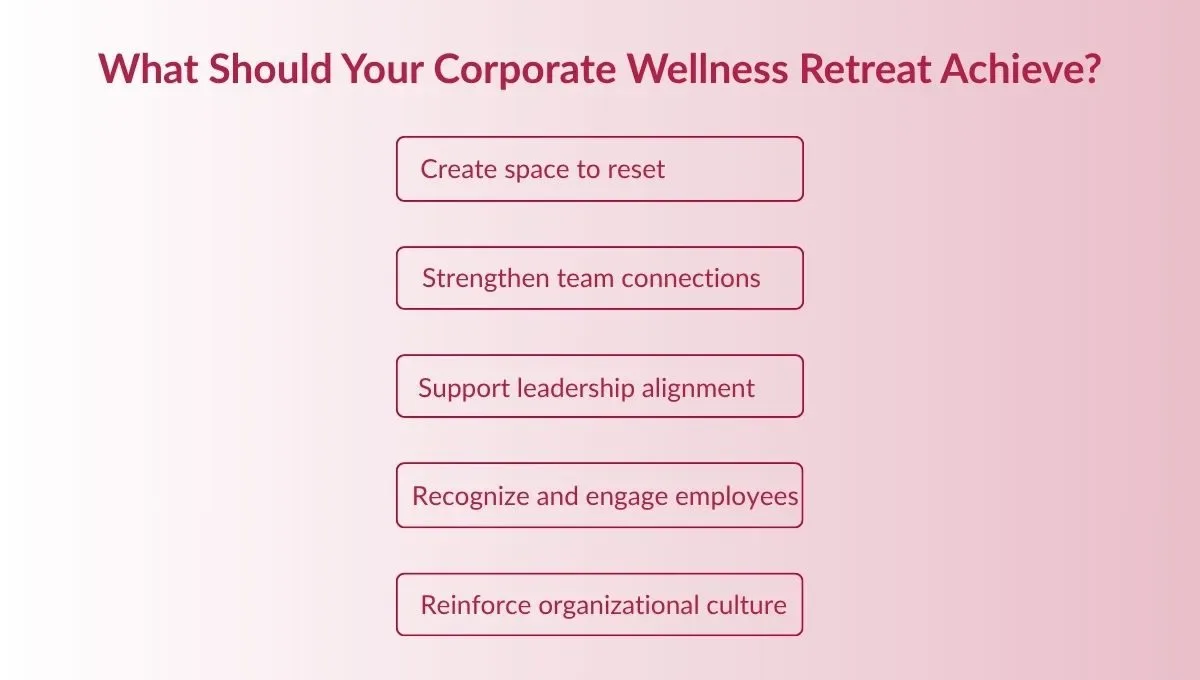
The first step to a successful corporate wellness retreat is to set a clear goal.
Before choosing a destination, venue or activities, ask:
So, what do employees or leaders bring back to work?
It could be new energy, more cohesive team dynamics, aligned leadership, quality recognition, or defined priorities.
Create space to reset
Following a challenging time, it may be better for staff if they are able to spend some time resting rather than having a full schedule.
Consider:
Comfortable accommodation
Slower mornings
Relaxing or gentle movement classes
Outdoor time
Unscheduled periods for rest
The intention is not to simply relocate the working week, but to provide a break from the usual working stress.
Strengthen team connections
Informal interaction may be limited due to busy schedules and hybrid working.
The opportunity to connect outside the teams and roles they work in can be achieved through shared meals, small group activities, cultural activities, and relaxed social time.
Support leadership alignment
Time must be set aside for leadership groups to meet strategy, planning, and decision making.
Enhanced retreat rhythm can be a balance between intense periods of work and rest, breaks, wellness, time outdoors and informal chats instead of an all-meeting day.
Recognize and engage employees
If a retreat is integrated into an employee recognition program, it should be different from a regular business trip.
Well planned meals, health activities, and relaxing stays can make it more fulfilling.
Reinforce organizational culture
A retreat can provide an opportunity for conversations about common values, collaboration, and future priorities.
The objective is not to address all organizational issues during the retreat. It's to have more meaningful discussions and define more solid steps for the workplace.
How Do You Choose the Right Corporate Retreat Destination in Nepal?
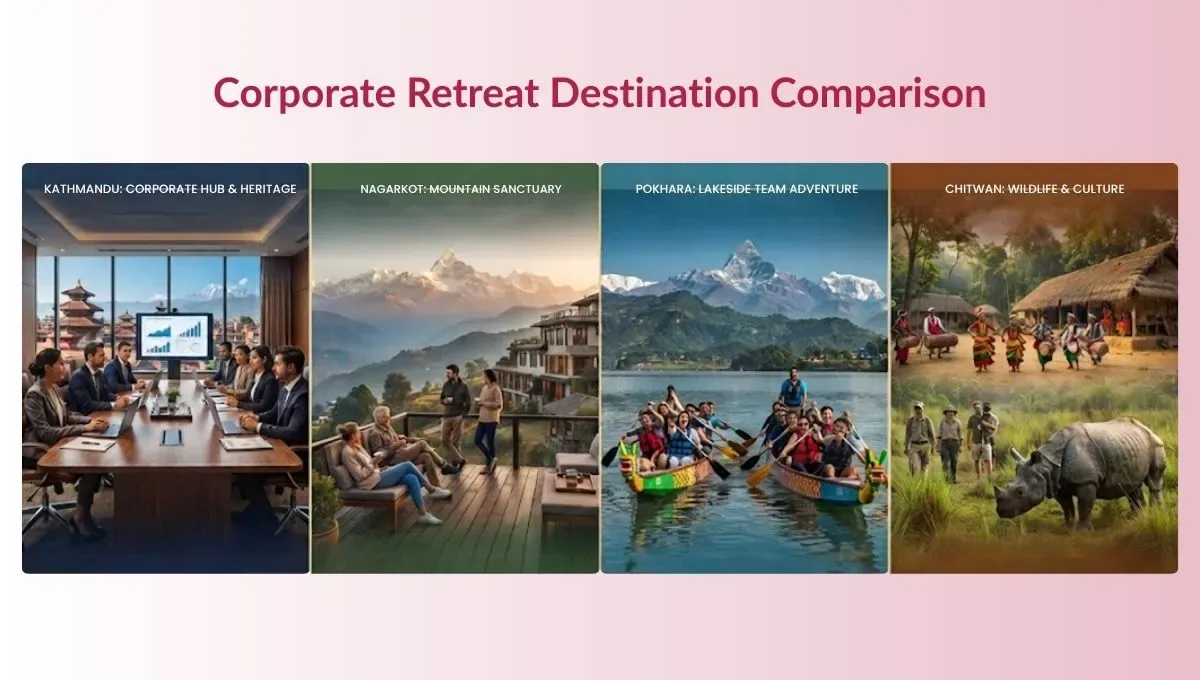
There is no single best destination for every group.
Consider:
Group size + travel time + business requirements + desired experience
Kathmandu: practical for larger programmes
Kathmandu is a good choice if the retreat requires significant meeting facilities, ease of travel from the airport, and accommodation within one property.
This Soaltee Kathmandu in Tahachal is about 9 km away from Tribhuvan International Airport and currently has 285 rooms and suites, 12 acres of landscaped grounds, five dining destinations and over 25,000 sq. ft of meeting and event space.
Best suited to: larger corporate groups, international delegates and programmes combining meetings with wellness and leisure.
Plan your programme: Soaltee Meetings & Events
Nagarkot: suited to smaller, reflective groups
Nagarkot is quieter, offers a more serene hill excursion and may be better suited for leadership teams and smaller groups with a desire for a greater sense of getting away from it all.
Soaltee Westend Resort Nagarkot currently offers 42 rooms and suites across 10 villas and 2 suite villas, with meeting, dining and wellness facilities.
Explore Soaltee Westend Resort Nagarkot
Best suited to: Leadership offsite, strategy retreats and wellness-led programmes of a smaller size.
Pokhara: suited to nature-led programmes
Pokhara is appropriate when outdoor experiences are crucial to the programme.
Best suited to longer corporate offsites, active teams and nature-focused programmes.
Chitwan: ideal for destination led experiences
Chitwan offers a stronger nature and cultural dimension, allowing the destination to become part of the retreat experience.
Soaltee Westend Resort Chitwan currently combines accommodation and meeting facilities with wellness amenities and access to nature and cultural experiences.
Explore Soaltee Westend Resort Chitwan
Best suited to: executive groups, longer retreats and destination-focused programmes.
What Should HR Teams Look for in a Corporate Retreat Venue?
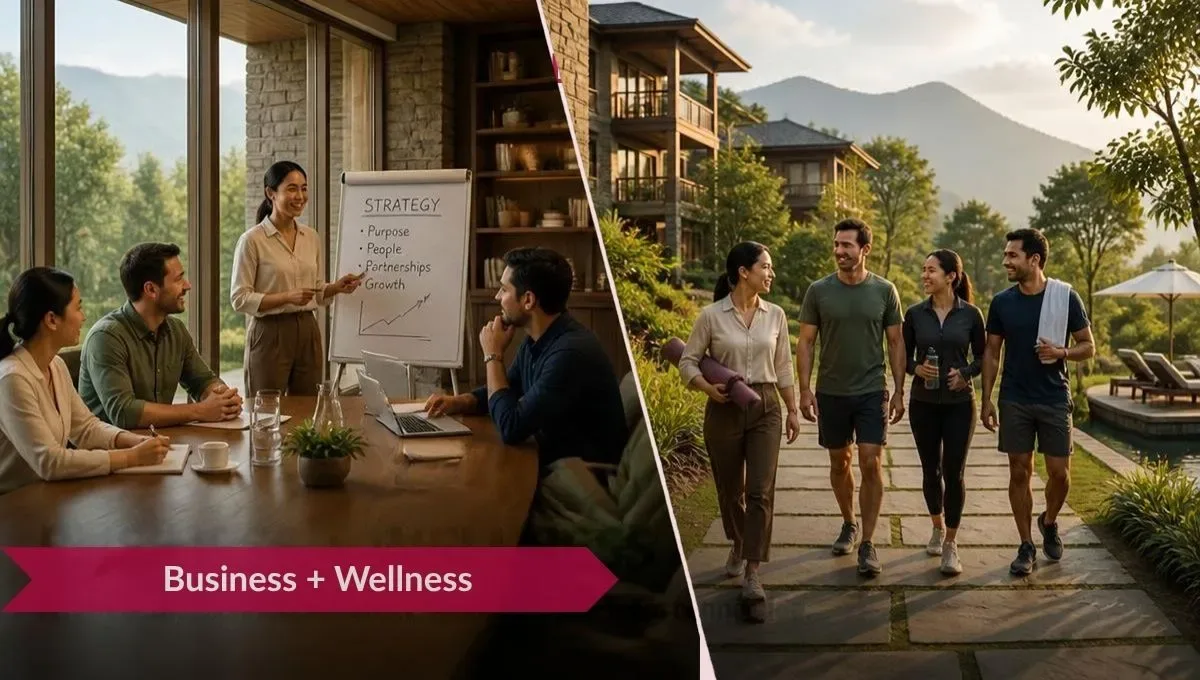
A proper corporate retreat destination in Nepal should be able to facilitate both business and wellbeing aspects of the programme.
Accommodation
Check:
Group capacity
Room allocation
Arrival and departure arrangements
Accessibility
Privacy requirements
Meeting facilities
Look for:
Plenary space
Breakout rooms
Boardrooms
Reliable Wi-Fi
Audio-visual support
Flexible layouts
Technical assistance
Our current Meetings & Events portfolio in the Soaltee Kathmandu comprises several halls and boardrooms, including the listed Grand Ballroom which is 10,296 sq. Ft. Soaltee Meetings & Events.
Related guide: Hotel Conference Venues in Kathmandu
Wellness and recreation
Being in a spa doesn't necessarily turn it into a wellness programme.
Consider:
Fitness facilities
Spa services
Swimming
Outdoor areas
Yoga or movement options
Quiet spaces
Opportunities for walking and relaxation
The Soaltee Kathmandu currently lists Tranquility Spa, fitness and recreation facilities, swimming and landscaped outdoor areas.
Explore Soaltee Spa & Wellness
You might also like: Luxury Spa in Nepal: Explore Soaltee's Wellness Experiences
Dining
For a multi-day programme, confirm:
Vegetarian and vegan options
Allergies
Religious dietary requirements
Group dining
Working lunches
Refreshments
Meal timings
Outdoor and informal spaces
Informal conversation and real down time is available outside of a specific session through gardens, terraces and walking space areas.
Planning guide: Top Amenities to Look for in Nepalese Corporate Event Venues
Which Wellness Activities Work Best for Corporate Groups?
The best activities are inclusive, practical, and easy to participate in.
Gentle movement
Yoga, stretching, or a guided morning walk can provide a calmer start to the day without requiring a particular fitness level.
Nature-based activities
Depending on the destination, consider:
Guided walks
Light hikes
Outdoor reflection
Garden activities
Nature experiences
Cultural experiences
Nepal also allows companies to include local culture as part of the retreat through:
Heritage visits
Local dining
Traditional music
Cultural demonstrations
Guided local experiences
Unstructured time
Allow time for people to relax, enjoy the spa, stroll, engage in conversation, or just get away from the routine.
A successful corporate wellness retreat is not about filling every hour. It is about creating the right balance between focus, connection, and recovery.
How Should You Structure a Three-Day Corporate Wellness Retreat?
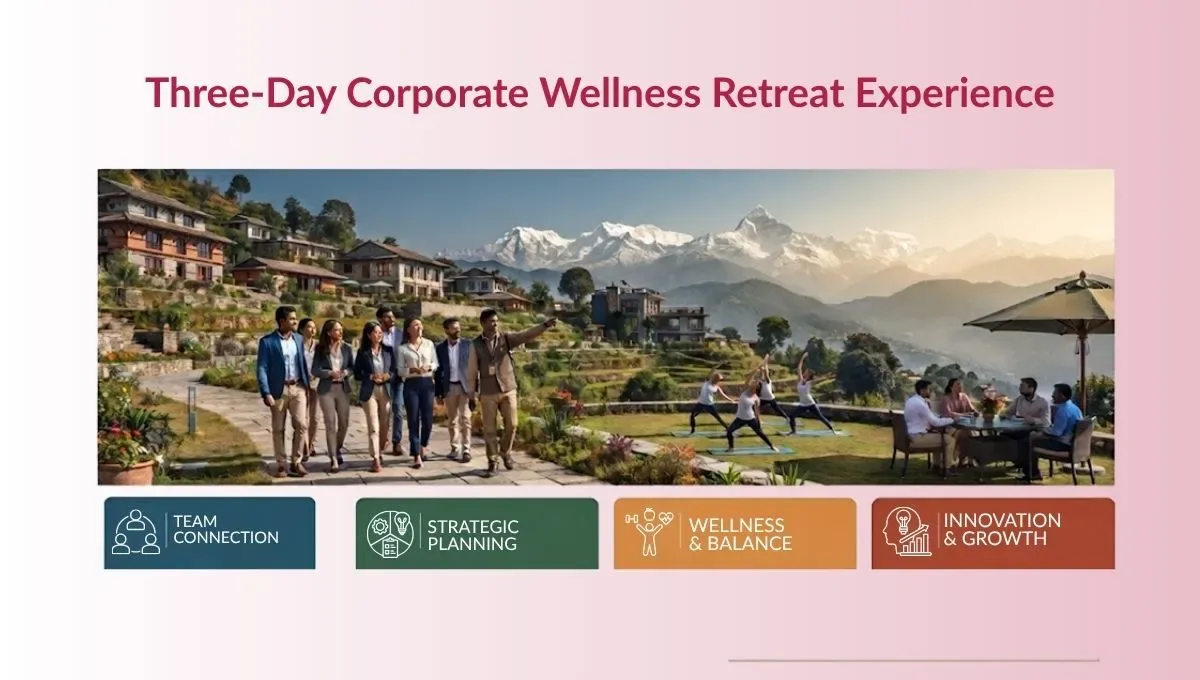
A three-day plan can be a balanced approach to business objectives, wellbeing, and social interaction.
Time | Day 1 - Connect | Day 2 - Focus | Day 3 - Reflect |
Morning | Arrival and orientation | Yoga or guided movement. | Reflection walks or wellness session |
Mid-morning | Opening session | Strategy or leadership workshop | Final discussion |
Midday | Group lunch | Lunch and informal time | Closing lunch |
Afternoon | Cultural or team activity | Breakout sessions or free time | Departure preparation |
Evening | Welcome dinner | Group dinner and cultural programme | Optional farewell gathering |
The schedule should reflect the objective of the retreat. You might want to have a more defined discussion on a leadership programme, or more free time at an employee wellbeing retreat.
When Is the Best Time for a Corporate Retreat in Nepal?
The timing should be in accordance with the destination and the activities to be carried out.
October and November can be good months for outdoor programmes after the monsoon, and spring may be good for a few nature-based programmes. Local weather varies by destination, please check before booking outdoor activities.
A practical approach is:
October-November: May be appropriate for outdoor and scenic programmes.
March-May: useful for many nature-led retreats, subject to conditions
December-February: suitable for programmes with a stronger indoor focus
June-September: allow greater flexibility around monsoon conditions
The business calendar is also an important factor. Whenever possible, do not schedule the retreat right before a big deadline.
How Much Does a Corporate Wellness Retreat in Nepal Cost?
There is no standard price because the total depends on:
Group size
Number of nights
Room category
Destination
Meals
Meeting facilities
Wellness services
Transport
Facilitators
Activities
An effective budgeting model is:
Core stay: Accommodation, meals and essential venue requirements.
Business programme: meeting space, AV and facilitation
Wellness programme: movement sessions and selected wellness services
Experience programme: transport, cultural activities and excursions
Request venues to break down inclusions and extra charges to make it easier to compare and internally approve proposals.
How Can HR Teams Make the Retreat More Inclusive?
Employees have different fitness levels, mobility requirements, preferences, and comfort levels with group activities.
Before finalizing the programme, consider:
Accessibility
Dietary requirements
Different fitness levels
Cultural considerations
Participation preferences
Time for privacy and rest
Wellness activities are best provided as an opportunity, not a requirement.
How Should HR Teams Measure Whether the Retreat Worked?
The retreat should be measured against the objective set before it begins.
Before the retreat
Establish a simple baseline around:
Team connection
Employee wellbeing
Morale
Leadership alignment
After the retreat
Ask:
What was most useful?
What could have been removed?
Was there enough time to disconnect?
Which experience created the strongest connection?
What should change next time?
30-60 days later
Look for a follow-through.
For leadership teams, that may mean strategic decisions made during the retreat being implemented. For employee groups, it could mean stronger collaboration or initiatives that emerged from the programme.
Corporate Wellness Retreat Planning Checklist
3-6 months before
Define the objective
Confirm group size and budget
Choose the destination
Compare venues
Review accommodation and meeting capacity
Request proposals
6-8 weeks before
Finalize room allocation
Confirm the programme
Arrange transport
Collect dietary and accessibility requirements
Confirm AV and event needs
1-2 weeks before
Reconfirm the itinerary
Confirm dining and room arrangements
Reconfirm transport
Share participant information
After the retreat
Gather feedback
Record agreed actions
Review outcomes
Schedule a 30-60-day follow-up
Why Can a Five-Star Hotel Be a Good Choice for a Corporate Wellness Retreat?
For HR teams, the value of a five-star hotel goes beyond accommodation.
A suitable property can bring together:
Accommodation + meetings + dining + wellness + recreation + event support
Having these elements within one managed environment can simplify planning and reduce the need to coordinate multiple suppliers.
The Soaltee Kathmandu combines 285 rooms and suites, 12 acres of landscaped grounds and more than 25,000 sq. ft. of event and meeting space with dining and wellness facilities.
For smaller groups, Soaltee Westend Resort Nagarkot provides a hill-based setting with accommodation, meeting and wellness facilities.
For destination-led programmes, Soaltee Westend Resort Chitwan offers another setting within the portfolio, with accommodation, meeting facilities, wellness amenities and access to nature and local experiences.
Our current Meetings & Events portfolio also spans destinations including Kathmandu, Nagarkot, Chitwan, Pokhara, Manakamana, Itahari, Nepalgunj and Bhairahawa.
The right property is therefore the one that best matches the group's objective, size, travel requirements, and preferred experience.
Plan the Retreat Around the People
The strongest corporate wellness retreats in Nepal are not necessarily the ones with the most activities.
They are the ones where the purpose is clear; the logistics are dependable, and participants have enough space to step away from normal routines.
For some organizations, that may mean a full-service corporate retreat in Kathmandu. For others, a smaller leadership programme in Nagarkot or a destination-led experience in Chitwan or Pokhara may be a better fit.
Start with the objective. Then choose the destination, venue, and programme around it.
Explore Meetings & Events at The Soaltee to discuss your group size, preferred dates, and corporate retreat requirements.
You Might Also Like
Top Amenities to Look for in Nepalese Corporate Event Venues
A practical guide to our facilities of HR and event planners should compare before selecting a venue.
Hotel Conference Venues in Kathmandu
Explore our meeting spaces, technology and logistical considerations relevant to corporate programmes.
Luxury Spa in Nepal: Explore Soaltee's Wellness Experiences
Explore our wellness and spa experiences across selected Soaltee destinations.
Frequently Asked Questions
What is a corporate wellness retreat?
A corporate wellness retreat is an organized company offsite that combines business objectives with opportunities for employee wellbeing, connection and recovery. It may include meetings, leadership sessions, movement, nature, cultural experiences, and unstructured time.
How long should a corporate wellness retreat in Nepal last?
There is no universal idea. Two nights can work for a focused local programme, while three or more nights can provide greater flexibility between business sessions, travel, leisure and recovery.
Which destination is best for corporate retreats in Nepal?
Kathmandu is practical for larger and business-led programmes. Nagarkot suits smaller and more reflective retreats, while Pokhara and Chitwan can work particularly well when nature and destination experiences are central to the programme.
What should HR teams look for in a corporate retreat venue?
Look for accommodation capacity, flexible meeting facilities, reliable connectivity, dining options, wellness facilities, outdoor space, accessibility, and professional event support.
Should wellness activities be mandatory?
It is generally better to offer wellness activities as opportunities rather than mandatory requirements, allowing employees to participate according to their preferences and abilities.
What is the best season for corporate retreats in Nepal?
October-November and spring can be attractive for many outdoor programmes, while city-based retreats can be organized year-round with appropriate planning for indoor and outdoor activities.