Key Highlights
Best time: February and March, during the dry season
Best areas: Rapti River corridor, Kasara grasslands, Sauraha buffer zone and Meghauli.
Best safari: Early-mornings jeep safari for good sighting chances
The months: Vegetation is open and water is limited, making it easier to spot rhinos
Remember: Wildlife sightings are never guaranteed
Any traveler who has visited Chitwan National Park will try to describe the experience, but words rarely do it justice. There was a wall of tall grass, the unobtrusive sound of a jeep driving through the early mist and then, all at once, 3 tonnes of an ancient beast standing still in the low light. The experience of spotting a one-horned rhino in Chitwan is not just a game of wildlife spotting; it's a journey into the heart of the jungle.
Spotting the one-horned rhinos in Chitwan isn't just a question of show up and hope. The park covers over 952 square kilometers and has been a UNESCO World Heritage Site since 1984.
Rhinos live in the park year-round, but your chances of seeing them depend on the timing, location, and type of safari you choose. Our Soaltee Westend Resort Chitwan is located on the Rapti River in Patihani, where rhino activity has been focused over the last few years.
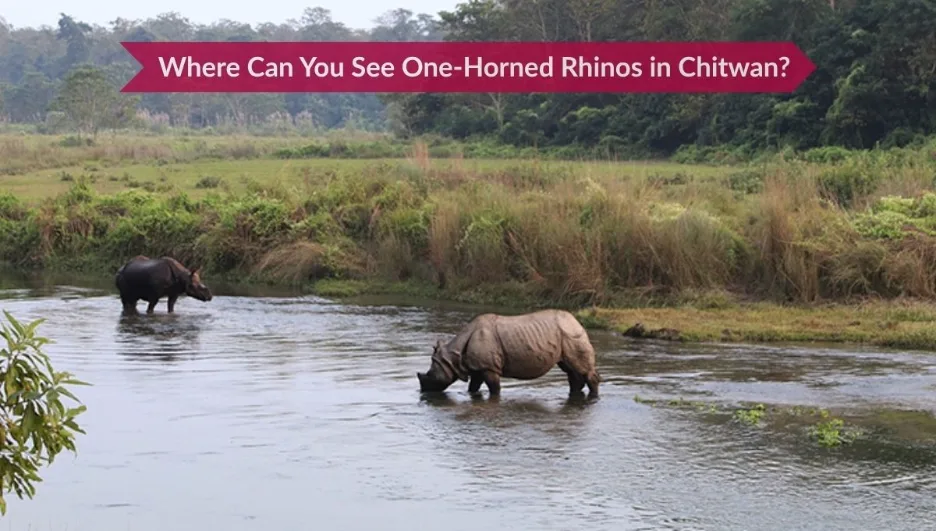
Where Can You See One-Horned Rhinos in Chitwan?
The Nepalese Rhino National census (2021) conducted by National Trust for Nature Conservation estimates that there are 752 greater one-horned rhinos in Nepal, of which 694 are found in Chitwan National Park. This recovery, from a small population in the 1960s, is one of the conservation success stories in Asia.
Rhinos are not evenly distributed in the park. They focus in certain areas and knowing these is the key to a productive morning and not three hours of beautiful empty jungle.
The rhinos are most likely to be seen along the Rapti River corridor. Rhinos come to the riverbank to drink, wallow in the mud, and cool off. Morning and late afternoon are great times to explore, and a quiet canoe ride is a great way to view the area by water.
Most visitors enter the park through Sauraha and its buffer zones and can be seen there throughout the season.
One thing a lot of first timers won't expect is that you don't always have to have a safari car to find one. In Chitwan, the rhinos are so much at home with the landscape that they sometimes just wander straight through the village itself; completely oblivious to motorbikes and pedestrians moving out of the way. Locals give just a quick look up.
It's one of those moments that's only possible in Chitwan: a two-tonne prehistoric beast cruising on the same road as a tea stall.
Taking a stroll around the edge of the river in the morning can be a chance for an unexpected early morning sighting before breakfast.
These inner pockets of grassland and Kasara are excellent areas within the park and in the drier months, open grasslands can be clearly seen. Our Chitwan wildlife safari guide covers these corridors in more detail. Spend the extra time in the quieter, less visited Meghauli on the western side of the park, tiger and rhino country.
Best Time to See Rhinos in Chitwan
The season does not indicate that you will see a rhino, but it might affect where rhinos will be, what they will look like and how easily you will find them. This is the key breakdown of our best time to visit the Chitwan guide.
October to November is when Chitwan wakes up after the monsoon. The temperature range is 15°C to 25°C, when things are comfortable for rhinos and multiple sightings can occur within a safari. This is peak season, and the lodges book up quickly.
December to February months are quiet, cooler and really underrated. Mornings bring mist of the grasslands, making for a quality of light that photographers come back to every year. The most important event of the Chitwan's calendar is this: the Tharu grass harvest. The Tharu people are granted traditional rights to cut grass from the buffer zones of the park, and harvesting of the grass makes a huge difference; a rhino at 30m can be seen at 200m. For this reason, February is one of the best months for rhino safaris, particularly for those interested in spotting one-horn rhinos in Chitwan.
March to May is the time of the year which serious wildlife enthusiasts recognize, and most visitors overlook. Rhinos and large mammals tend to cluster around the ponds and oxbow lakes during the dry season due to their scarcity. March is considered to be the strongest month. From April and May, temperatures rise to 40°C, but wildlife activity is even more focused near the water edge during the early morning hours. Make early morning drives and take afternoon naps during the shade hours.
June through September is the monsoon. The grass grows to be above head height; core safaris become inundated, and spotting is truly challenging. If spotting one-horned rhinos is your objective, then this is not the time to schedule around.
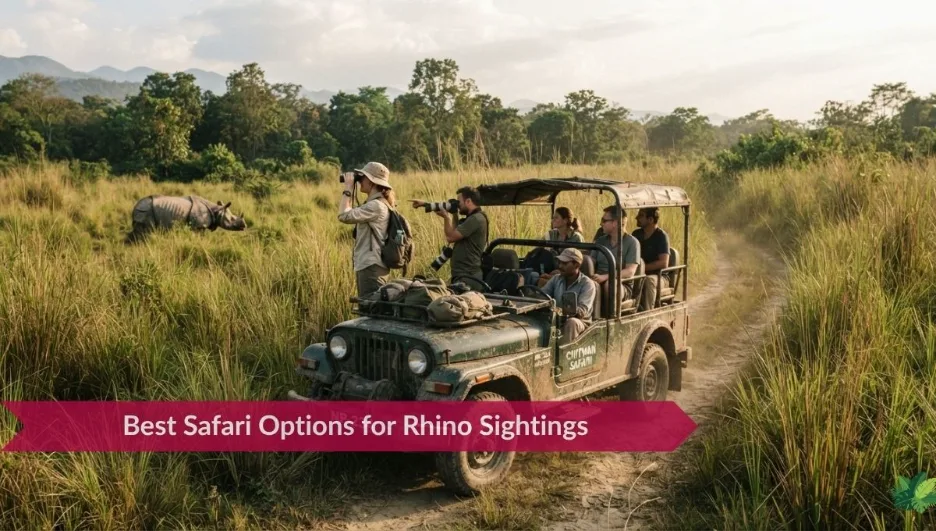
Best Safari Options for Rhino Sightings
The type of safari determines everything, from the speed and distance of your encounter with a rhino to the kind of quiet you experience. Let's compare the three formats:
Safari Type
Best For
Main Advantage
Jeep safari
For visitors for the first time, wide coverage
Covers more territory; highest overall sighting rate
Canoe ride
Riverbank encounters
Quiet approach; excellent close-range views at water
Walking safari
Wildlife enthusiasts
Immersive ground-level experience
The best starting point for a visit to Chitwan is the Jeep safari. A 4WD vehicle can operate very efficiently in the core areas, access the deeper forest and oxbow lakes and offer the stability required for photography. Jeep safaris offer some of the best opportunities for rhino sighting during the dry season. In this Chitwan National Park safari guide, we discuss permit details, timing and packing.
Canoe ride on Rapti River is quiet, no engine noise, no sudden movement. Perhaps it is the best way to get close to the water edge to see the rhinos drinking, and in terms of individual encounters there's very little like it.
A walking safari is the most immersive and requires the greatest attention to safety and is done with a licensed naturalist. On foot tracking (reading fresh pugmarks in riverine sand, listening for a spotted deer's alarm call) is something no vehicle can do. It is also the format in which there is a real threat; guides aren't armed, and up-close-and-personal encounters with big game need strict safety procedures to be followed.
How Many Safaris Should I Take?
Many itineraries fail to give a straightforward answer to this question. The quick answer: two or more, preferably in various formats.
Wildlife viewing is never guaranteed, whether in season or on a route. There's an excellent chance of a rhino sighting on a single morning jeep drive, but a jeep safari and a canoe ride (or a jeep drive and walking trail) go at different times of the day, in different parts of the park, and in different directions. The canoe is in the river, the jeep on the riverbank, the deeper grassland corridors that the canoe can't reach.
The majority of visitors who stay for 2-3 nights can easily schedule a morning jeep drive, a canoe ride and a walking safari, thereby covering the ground of the park in a manner that truly increases their sighting possibilities. This is incorporated into our best things to do in Chitwan for first time visitors guide that is a practical 2-night plan.
Behaviour, Habitat, and What Makes Chitwan Rhino Country
The "greater one-horned rhino" (Rhinoceros unicornis) requires three things: water, cover in the form of tall vegetation, and sufficient contiguous space to travel between these. All three are provided by this ecosystem of Chitwan that includes dense sal forest, high elephant grasslands, riverine forest along the Rapti and Narayani and scattered oxbow lakes.
Understanding the animal can be helpful. The greater one-horned rhino is largely solitary and can go as fast as 55 km/h over short distances, which is more than most people would imagine an animal of its size. Males are territorial, calves of females are most unpredictable and will charge if they are threatened. No armed guides are allowed in Chitwan. The most important thing is to have a naturalist that understands body language before it's too late.
Rhinos are consistent in their grazing, wallowing and return to the same spots on the same riverbank, the same wallow spots and the same grazing clearings year after year. A good guide is familiar with these patterns. It is on that basis that we have our wildlife encounter experiences during our Chitwan safaris.
What Are Your Chances of Seeing a Rhino?
Chitwan has one of the highest number of rhinos in protected areas in Asia. Several sightings can occur on one morning jeep safari during the dry season; specially near the water sources and edges of open grassland areas. Jeep safaris offer some of the best opportunities for rhino sightings during the dry season, particularly around open grasslands and remaining water sources. Encounters in the Rapti corridor and Sauraha buffer zone are always good in October-November.
However, no sightings are guaranteed. The jungle is not on schedule, and any operator that says they will have specific encounters is being unrealistic. The odds are indeed in your favour with the right habitat, correct population density and knowledgeable guides as Chitwan has all three.
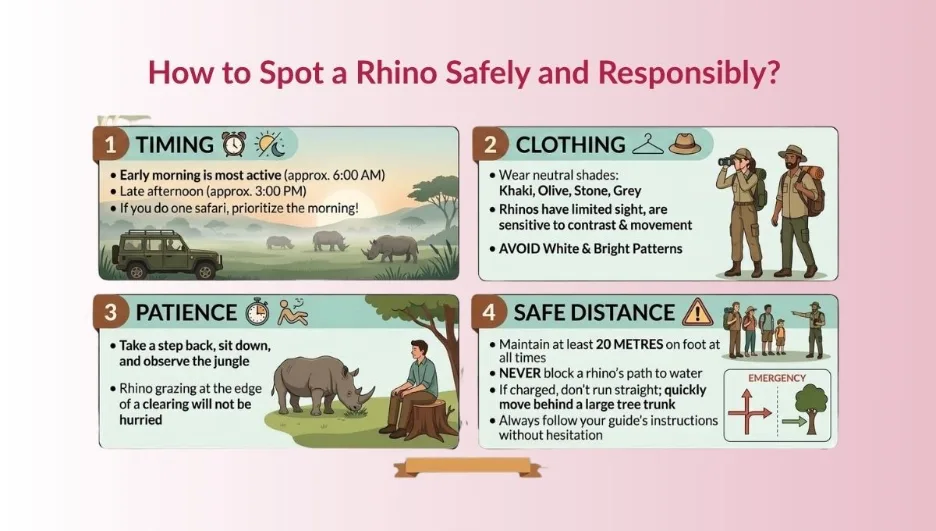
How to Spot a Rhino Safely and Responsibly?
Timing: Early morning is the time with the most rhino activity (around 6:00 AM) and late afternoon (around 3:00 PM). If you can do only one safari, make it early in the morning.
Clothing: Neutral shades (khaki, olive, stone, grey). Rhinos have limited sight but are sensitive to contrast and movement. Avoid white and bright patterns.
Patience: Take a step back, sit down, and observe the jungle. Rhino grazing at the edge of a clearing will not be hurried.
Safe distance: Maintain at least 20 meters on foot at all times. Never block a rhino's path to water. If a rhino charges, don't run in a straight line, but quickly move behind a large tree trunk. Always follow your guide's instructions without hesitation.
If you want to see more than the rhino trails, then here is the top places to visit in Chitwan guide to cover the broad spectrum of what is found throughout the park.
Other Wildlife You May See Alongside Rhinos
Chitwan safari is never an experience with just one animal. Bengal tigers, Asian elephants, gharial crocodiles, sloth bears, leopards and more than 500 bird species reside in the park. Birdwatchers should explore our birdwatching guide for Chitwan for the best zones and species to look for.
The Tharu people of the Terai region, who have inhabited the region for centuries, have coexisted with these animals, and their knowledge has influenced the landscape that has become the home of the rhinos. A trip to the Tharu cultural experience in Chitwan is truly adding to the wildlife experience, which a safari cannot offer.
Where to Stay for a Rhino Safari?
The location in Chitwan determines when you can get away, and how easy it is to get to productive safari corridors. On the edge of the buffer zone, properties can provide an earlier departure, and enjoy the unexpected sighting, like a rhino wandering through the garden edge at dusk, which is never seen on any itinerary.
Our Soaltee Westend Resort Chitwan is located in Patihani, on the western side of the park, where rhino sightings have been more frequent. Soaltee Heritage Hour, our signature Hi-Tea ritual, exclusive to Soaltee Heritage Club members. Every evening from 5:30 to 6:30 PM, unwind with light snacks and pastries after a day of sightseeing. Gold, Platinum, and Signature members also enjoy selected house beverages. Two to three nights is sufficient time for a morning jeep tour, a canoe trip on the Rapti, a stroll around the walking trail and an evening of culture.
Ready To Plan Your Chitwan Visit?
Our team can help you time your trip for the best conditions and arrange everything from safari permits to accommodation. Contact us, we are here to help you make the most of your time in Chitwan.

FAQ
Where are rhinos most seen in Chitwan National Park?
The best places to see rhinos in Chitwan are the Rapti River corridor, Sauraha buffer zones, Kasara grasslands and Meghauli
What is the best time to see one-horned rhinos in Chitwan?
February and March are among the best months for rhino spotting. The dry season brings out the vegetation and draws the animals to water sources.
What time of day is best for rhino spotting in Chitwan?
Rhinos are most active early in the morning, usually around 6:00 AM and you'll find good visibility at this time.
Which safari is best for seeing rhinos in Chitwan?
For exploring extensive grasslands, a jeep safari is the best option. A canoe ride is ideal for quiet riverbank encounters, whereas a walking safari is more immersive, with increased safety considerations.
Can you see rhinos outside Chitwan National Park?
Yes. Rhinos are sometimes spotted around the fringes of the buffer zone and around Sauraha, often close to the riverbank and in the early morning. But sighting is not guaranteed.
What should you do if a rhino charges during a walking safari?
Do not run in a straight line, move behind a large tree or other large cover, and immediately follow your guide's instructions.
Are one-horned rhino sightings guaranteed in Chitwan?
Wildlife sightings are never certain. There are great opportunities in Chitwan, but each safari is unpredictable, due to its suitable habitat, population of rhino, and experienced guides.